
What is Myocarditis?
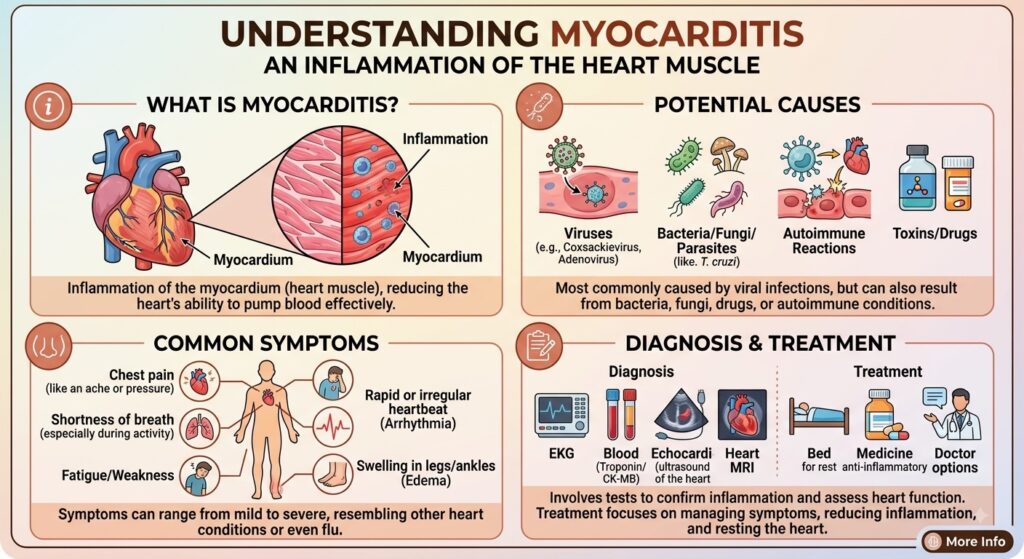
Myocarditis is an inflammation of the heart muscle. It’s usually caused by viral infections affecting the heart, but can also happen due to toxins or poisons. When the heart muscle gets inflamed, it gets weakened — and as a result, the heart’s pumping becomes weaker and less efficient.
What is Dilated Cardiomyopathy (DCM)?
Dilated cardiomyopathy (DCM) is a disease of the heart muscle, where the muscle gets progressively weaker over time and the heart’s pumping becomes weaker and less efficient. DCM can be caused by certain genetic conditions, can follow an episode of myocarditis, or can sometimes occur without any clear cause at all.
What causes Myocarditis in children?
The most common cause is a viral infection — common culprits include coxsackievirus, adenovirus, and parvovirus, and we’ve also seen cases linked to COVID-19. The virus itself doesn’t always directly damage the heart; often it’s the body’s own immune response to the infection that ends up inflaming the heart muscle. Less commonly, myocarditis can be triggered by certain medications, toxins, or autoimmune conditions.
What causes DCM in children?
DCM has three broad causes. It can run in families due to an inherited genetic mutation — which is why we often recommend genetic testing once DCM is diagnosed. It can also develop as the aftermath of a myocarditis episode that didn’t fully resolve. And in a fair number of children, despite thorough testing, we simply don’t find a specific cause.
What are the symptoms and signs of Myocarditis and DCM, and how does one tell the two apart?
Myocarditis usually comes on suddenly, with a short history of symptoms — sometimes just days. DCM tends to build up more gradually, though it can also suddenly get worse. That said, there’s real overlap between the two, and in a newly diagnosed child, it’s often genuinely difficult to tell them apart at first.
In both conditions, children can have worsening breathlessness, difficulty breathing, swelling of the face or legs, and reduced ability to exercise or play. More seriously affected children may go into cardiogenic shock, where the blood pressure can’t be maintained — these children may need ICU admission, ventilation, and medications to support their blood pressure. On investigation, myocarditis usually shows up with markedly raised cardiac enzymes (blood markers that indicate heart muscle damage), while DCM more often shows a genetic abnormality on testing.
What are the early warning signs parents should watch for at home?
In older children, look out for unusual tiredness, breathlessness with activities that were previously easy, a persistent cough, poor appetite, or complaints of chest discomfort. In infants, the signs can be much subtler — poor feeding, excessive sleepiness, unusual fussiness, fast breathing, or sweating while feeding are all worth getting checked out. If any of these follow a recent viral illness — a cold, flu, or stomach bug — it’s worth mentioning that history to your doctor, as it can be an important clue.
How are myocarditis and DCM diagnosed?
We start with a clinical examination and an echocardiogram (echo), which shows us how well the heart is pumping and its size — this is usually the first and most useful test. An ECG helps check the heart’s electrical activity. Blood tests check cardiac enzyme levels and look for signs of inflammation or infection. Depending on the picture, we may also recommend a cardiac MRI, which gives more detail on inflammation and scarring in the heart muscle, and in select cases, genetic testing to look for an inherited cause of DCM.
What treatment do children with myocarditis or DCM actually receive?
Treatment depends on how sick the child is at diagnosis. Milder cases are managed with heart failure medications that reduce the workload on the heart and help it pump more efficiently — this combination is called GDMT (guideline directed medical therapy), and it’s started step by step, adjusting the doses as the child tolerates them. In myocarditis specifically, we sometimes add medications like IVIG or steroids to calm down the inflammation, depending on the specific situation. Children with fluid buildup are given diuretics to ease breathlessness and swelling. The sicker children — those in shock — need ICU-level care, and in the most severe cases, mechanical support like ECMO, which we’ll come to below.
What are the long-term outcomes of Myocarditis?
Any newly diagnosed myocarditis patient can have one of three outcomes:
1. Complete recovery of the heart’s function, eventually allowing all cardiac medications to be stopped.
2. Partial recovery, where the child needs long-term heart failure medications but can otherwise lead a fairly normal, if somewhat restricted, life.
3. Progressive worsening despite treatment — these children go on to develop dilated cardiomyopathy, and will eventually need either a heart transplant or, sadly, may not survive the heart failure.
What are the long-term outcomes of DCM with treatment?
There are now several groups of medications available for heart failure in children with DCM. These are started in a step-by-step way, following established treatment guidelines — together, this approach is called GDMT (guideline directed medical therapy). The earlier this treatment starts in the course of the illness, the better the chances of improvement. Not every child tolerates every medication, though, so the combination has to be tailored to each child’s blood pressure, symptoms, and tolerance.
Even with the best medical therapy, many children with DCM will eventually see their symptoms worsen and go on to need a heart transplant.
What is ECMO, and how does it help in myocarditis or DCM?
ECMO (Extracorporeal Membrane Oxygenation) is a machine that’s surgically connected to a child’s blood vessels to take over the work of the heart and lungs for a period of time, supporting the body’s circulation when the heart is too weak to do it alone. ECMO itself doesn’t cure myocarditis — what it does is buy time, allowing the heart to rest and recover with the help of medications, while the machine keeps the circulation going.
In children with acute myocarditis, we’ve occasionally used ECMO for around 7–14 days to give the heart a chance to recover. In many of these cases, the child has been successfully weaned off ECMO and gone on to make a good recovery.
What are the long-term outcomes of heart transplantation?
Heart transplantation comes with real, ongoing challenges. Beyond the cost and the need for lifelong medication, transplanted children need regular, lifelong follow-up. Once a donor heart is available and the transplant is done, the child needs to stay on immunosuppression for life — this is medication that stops the body’s immune system from recognising the new heart as foreign and attacking it. If immunosuppression isn’t managed properly, the body can reject the transplanted heart.
Even with the best follow-up and immunosuppression, transplanted hearts tend to develop complications — including coronary artery disease — within about 10 to 15 years. So the decision to go ahead with a pediatric transplant isn’t a simple one: realistically, the transplanted heart works well for roughly the next one to two decades. And throughout this time, because immunosuppression weakens the immune system, the child remains at higher risk of serious infections.
Can myocarditis come back, or is it usually a one-time illness?
For most children, myocarditis is a one-time event, and once the heart recovers, it stays recovered. That said, a small number of children can have a recurrence, particularly if the underlying cause is autoimmune rather than a simple viral infection. This is one of the reasons we recommend continued follow-up even after a child appears to have fully recovered.
If a child is diagnosed with DCM, should other family members be checked too?
Yes, this is worth discussing with your doctor. Because DCM can run in families, when a child is diagnosed, we often recommend that parents and siblings have a screening echocardiogram, and depending on the situation, genetic testing as well. Picking up DCM early in a family member — before symptoms even start — makes a real difference to how early treatment can begin.
Can a child fully return to sports and normal activity after myocarditis?
Some children can return to full, unrestricted activity — but only once we’ve confirmed that the heart’s function has recovered completely, usually through follow-up echocardiograms and sometimes an exercise test or cardiac MRI.
We generally recommend a period of rest from competitive sports (often around 3–6 months) after the acute illness, even if the child is feeling fine, since the heart muscle needs time to heal and there’s a small risk of dangerous heart rhythms during this recovery window. Every child’s timeline is different, so this decision is always made on a case-by-case basis, based on how the heart is doing on follow-up tests — not just on how the child feels.
How long does follow-up continue after a child recovers?
Even after full recovery, we continue periodic follow-up with clinical checks and echocardiograms — typically for at least a couple of years, sometimes longer depending on the child’s initial severity and cause. This is mainly to catch any early signs of the heart function slipping, or, in rare cases, a recurrence, well before it becomes symptomatic.